Authors: Audrey Gent, Client Strategy Director & Trevor Lambert, Senior Strategist & AI Lead
The AI Noise vs. The Pharma Reality
Artificial Intelligence (AI) is everywhere. It dominates headlines, conference agendas, and leadership conversations. In pharma, the pressure to “have an AI strategy” is growing fast.
But here’s the reality: while AI has the potential to add real value, most mainstream conversations don’t resonate with pharma teams. The conventional use cases are often misaligned, the risks understated or not entirely known, and the practical guidance can be missing. For an industry defined by strict compliance codes and responsibilities to HCPs and patients, hype is not helpful.
For anyone working in pharma – whether in marketing, medical, compliance, or field teams – the realities are clear:
- You can’t experiment freely. Every new channel, tactic, or tool must be evaluated through regulatory frameworks.
- The bar for trust is higher. Patients and healthcare professionals expect information that is accurate, balanced, and well-sourced.
- Mistakes are costly. A single compliance breach or misjudged message risks reputational and financial harm that can take years to rebuild.
This doesn’t mean AI is off-limits. It means adoption must be practical, cautious, and grounded in ethics and compliance. Inflated promises don’t help the industry move forward.
What’s needed is a more honest, pharma-specific conversation: one that recognises and outlines the risks, highlights the opportunities, and focuses on practical ways AI can support day-to-day work, while maintaining customer trust.
Clear, actionable guidance is a must for pharma businesses using AI and well-considered use-cases, as AI will not solve every challenge.
Why Hesitation Exists – And Why It’s Valid
If you’re working in pharma today, the AI conversation may feel familiar:
- Leadership asking, “What’s our AI strategy?”
- Colleagues experimenting with tools, unsure whether it’s acceptable.
- Compliance teams wary of risks they haven’t yet fully defined.
And meanwhile, you may be asking yourself: Where is this genuinely useful in my role?
These aren’t signs of resistance – they’re signs of responsibility. This kind of scrutiny is what has always safeguarded pharma. When applied to AI, it can help ensure adoption is not only safe but sustainable.
Cutting Through the Hype
So, what can AI genuinely do for people working in pharma today?
The following examples are suggestions only – every organisation will need to determine what’s appropriate within its own policies and frameworks. But they reflect some of the most realistic near-term applications:
- Faster insights – Summarising research reports, clinical literature, or customer engagement data to surface emerging trends.
- Operational support – Automating administrative tasks like meeting summaries, data formatting, or asset tagging, freeing up time for higher-value activities.
- Content and document drafting – Producing first drafts of briefing notes, training materials, or content that experts refine and approve.
- Compliance and governance support – Helping manage version control, consistency checks, and audit-ready documentation.
- Capability building – Supporting L&D teams in creating modular training resources and tracking learning progress.
None of these use cases are revolutionary – and that’s the point. The real opportunity in pharma isn’t in bold experiments that grab headlines. It’s in practical enhancements that make work easier, faster, and more accurate, without compromising compliance or patient safety.
Where AI Does Not Fit (Yet)
Being realistic also means recognising limits. AI today cannot:
- Replace MLR review.
- Guarantee scientific accuracy.
- Replicate the human empathy or judgement needed in patient and HCP engagement.
- Remove the requirement for human oversight in decision-making.
Acknowledging these boundaries helps prevent inflated expectations and protects the credibility of teams exploring AI responsibly.
Moving from Curiosity to Capability
For pharma organisations, the next step isn’t rushing into providing access to the latest AI platform or tool. It’s building a strategy and both a short- and long-term approach to use AI thoughtfully. This covers:
- Clear governance – AI guardrails defining what’s acceptable, what’s not, and where oversight is required, alongside what approved AI tools are available and for what roles and use cases.
- Small, safe pilots – Controlled experiments in low-risk areas, focused on learning rather than scale, testing AI opportunities for the company.
- Capability building – Upskilling teams to ask the right questions of AI, not to rely on tools blindly. This should be pharma-specific AI education. AI training tailored to regulatory, ethical, and operational realities.
- Change management – Supporting colleagues at different levels of readiness, setting clear expectations, and ensuring progress is inclusive so no one is left behind.
This measured approach is how pharma builds trust – in technology, and in its ability to apply it responsibly.
A Bridge to More Advanced Applications
Seen this way, AI in pharma isn’t a revolution – it’s an evolution. By first building trust in the technology through practical, compliant use cases, organisations lay the foundation for more advanced applications across functions:
- In customer experience and marketing, moving from reactive campaigns to predictive, proactive engagement.
- In medical affairs, enabling more dynamic scientific exchange and enhanced field support.
- In compliance, using AI for smarter monitoring, auditing, and early risk detection.
- In L&D and capability, creating adaptive learning experiences that evolve with individual and team needs.
These developments aren’t immediate. But they are within reach for organisations that approach AI adoption with governance and strategy at the core.
This is exactly where we’ll go next in our AI in Action series – starting with how AI is shifting pharma CX from reactive to predictive, enabling more proactive and personalised engagement.
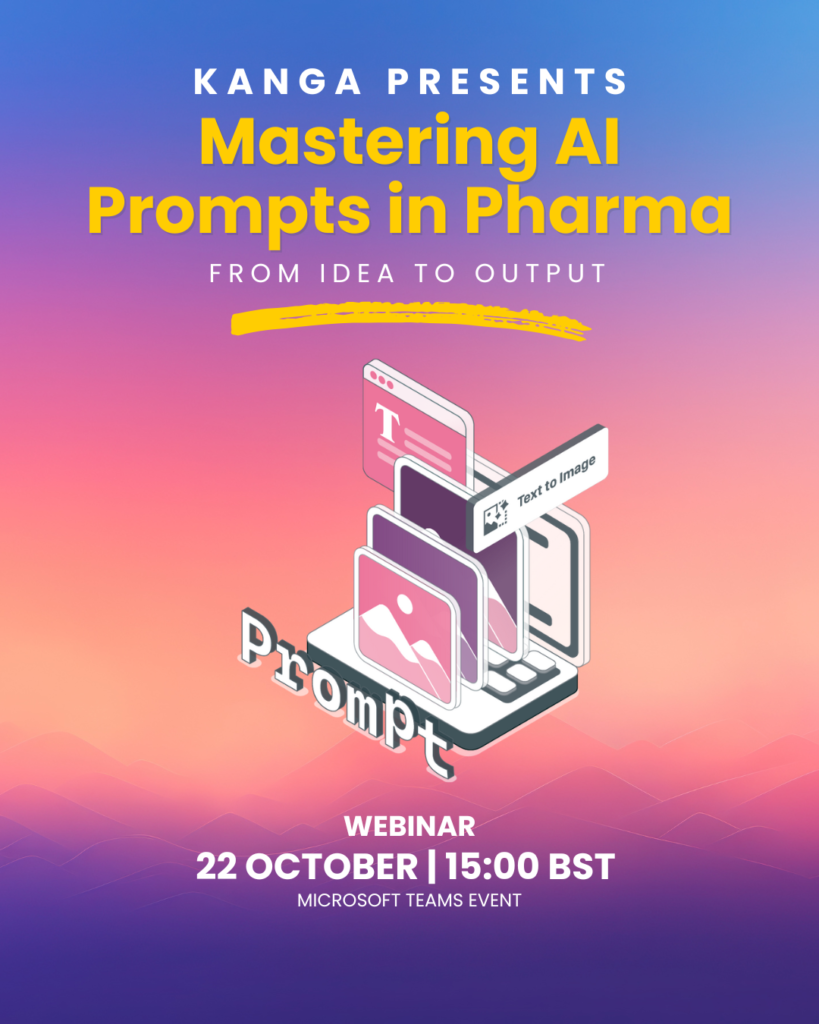
Ready to Put AI Into Action?
Ever asked AI for help and got something… completely off?
In pharma, the stakes are too high; one wrong prompt can mean flawed trial summaries, mistranslated treatment guidance, or forecasts that steer launches off course.
Join Kanga’s webinar to learn how to take control of AI. In just one session, you’ll gain a clear, easy-to-use prompting framework designed for pharma – so your outputs become reliable, relevant, and ready to use.
Register today and turn AI from guesswork into a game-changer for your role: